Supplier's GST cancelled later? The Supreme Court just protected the genuine buyer's ITC
Almost every business that buys on GST carries a quiet worry: you pay your supplier, you claim input tax credit (ITC) in good faith, and months later the department cancels that supplier's registration — then turns around and demands the credit back from you. In July 2026, the Supreme Court drew a firm line around that practice. It let stand an Allahabad High Court ruling that a genuine, well-documented buyer cannot be dragged through a Section 74 demand merely because the supplier was later deregistered, or because something went wrong further up the supply chain.
The case in brief
- Who: Safecon Lifescience Pvt Ltd, a pharmaceutical trader-manufacturer, bought goods from M/s Unimax Pharma Chem in April 2021.
- The transaction was clean: the supplier was registered under GST and held a valid drug licence at the time; the purchase was backed by a tax invoice, e-way bill, transport bilty and payment through banking channels; and the supplier had filed GSTR-1 and GSTR-3B.
- The problem: the supplier's registration was cancelled afterwards, and it later emerged that the supplier's own vendors had allegedly not paid tax. Acting on a tip from the Central Intelligence Unit, the department issued a Section 74 notice to Safecon, reversed the ITC, and confirmed the demand in adjudication and appeal — leaning heavily on Section 16(2)(c).
What Section 74 actually requires
This is the heart of it. GST gives the department two recovery routes. Section 73 is the ordinary one, for tax short-paid or ITC wrongly availed without any dishonesty. Section 74 is the serious one — it can be used only where the shortfall is "by reason of fraud, or any wilful misstatement or suppression of facts to evade tax." Section 74 carries a longer time limit and a much heavier penalty, so it cannot be reached for as a default.
You cannot be put through Section 74 unless there is a finding that you acted with fraud or intent to evade tax — not merely that tax went unpaid somewhere else in the chain.
The department's own CBIC circular dated 13 December 2023 says exactly this: Section 74 may be invoked only where there is material indicating fraud, wilful misstatement or suppression of facts to evade tax, and that material must form part of the show-cause notice. The High Court noted that the circular was issued precisely because dealers were being harassed under the guise of Section 74.
What the Court held
- Once Safecon had established the genuine movement of goods and payment of tax — and the department never rebutted that evidence with anything cogent — a Section 74 demand could not be sustained.
- No authority, at any stage, had recorded a finding that Safecon itself committed fraud, wilful misstatement or suppression. So the very invocation of Section 74 was legally unsustainable.
- The proceedings rested entirely on a Central Intelligence Unit report that was never even shared with the taxpayer — a breach of natural justice.
- The Court followed its earlier ruling in M/s Khurja Scrap Trading Company and the Supreme Court's decision in Continental Foundation Joint Venture Holding v. CCE (2007) 10 SCC 337, which holds that "suppression" and "wilful misstatement" require an intent to evade — they cannot be inferred from a mere omission or error.
The High Court therefore quashed both the adjudication order and the appellate order. The department carried the fight to the Supreme Court, which dismissed its Special Leave Petition — "we do not find any good ground to entertain this petition." The High Court ruling is now final.
This fits a clear judicial trend
Safecon is not a one-off. Courts have repeatedly protected the honest buyer from a supplier's sins:
- Suncraft Energy (Calcutta High Court, 2023): ITC cannot be denied for a GSTR-2A vs 3B mismatch without the department first investigating and proceeding against the defaulting supplier. The Supreme Court dismissed the department's appeal.
- D.Y. Beathel Enterprises (Madras High Court, 2021): where a supplier collected tax from the buyer but did not deposit it, recovery should be made from the supplier first — not by reversing the buyer's credit without even examining the seller.
The common thread: the tax administration must chase the actual defaulter, not simply reverse the credit of the nearest genuine buyer because that buyer is easier to reach.
Update — 24 July 2026: the other half of the story
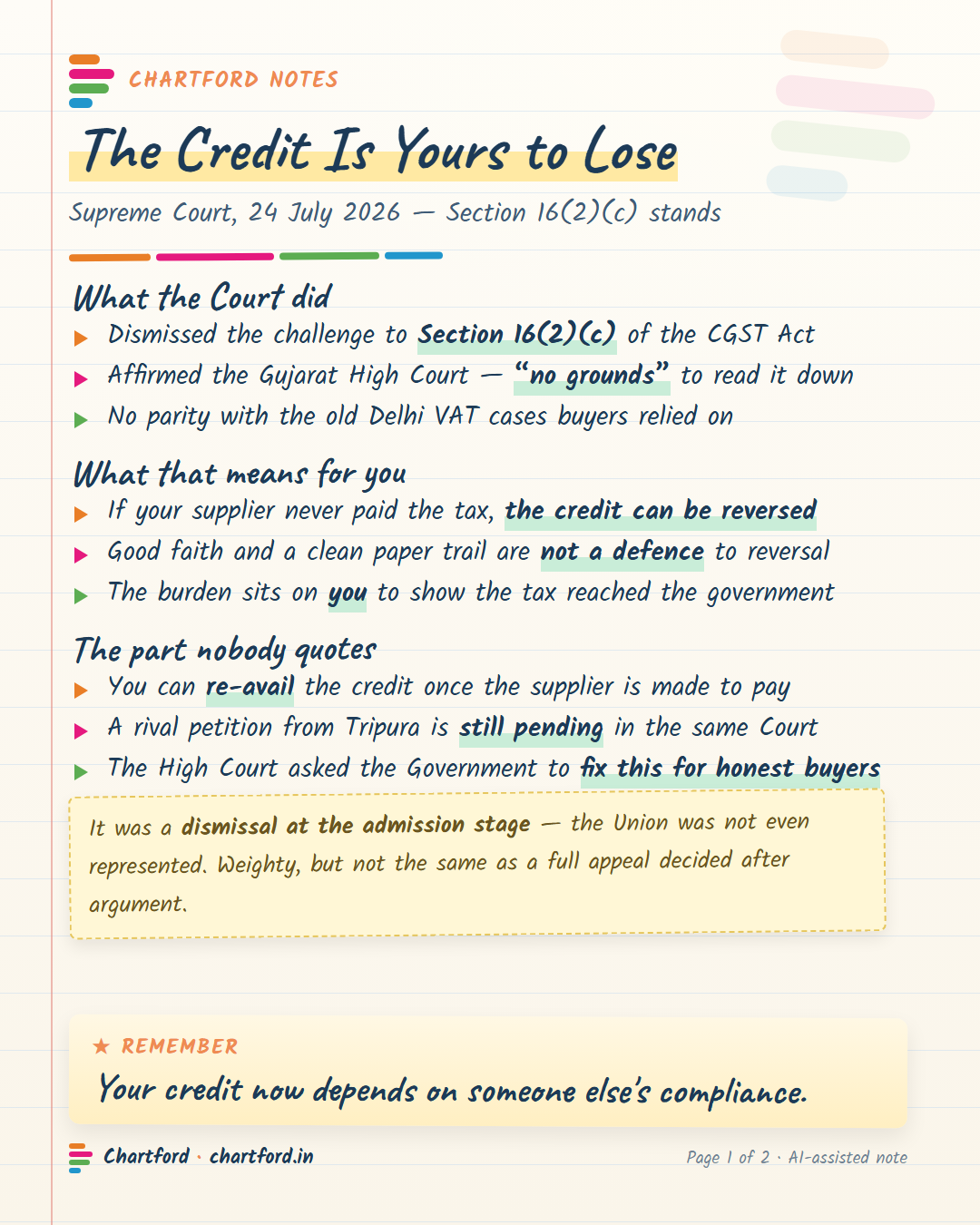
Two days after this note was published, the Supreme Court dismissed a challenge to Section 16(2)(c) and affirmed the Gujarat High Court, finding “no possibility of drawing parity” with the Delhi VAT cases. The effect: where a supplier never paid the tax, a genuine buyer’s credit can still be reversed — good faith is not by itself a defence to reversal, though the credit may be re-availed once the supplier is made to pay.
That does not disturb what this case decided. Safecon is about a Section 74 fraud demand raised against a documented buyer, and the protection against being branded a fraudster stands. But protection from a fraud allegation is not the same as keeping the credit. The new position is set out in full in what happens when your supplier does not pay the GST.
The honest limits — this is not a free pass
It is important to read the ruling for what it says, not for more. This protects genuine, documented purchases. Section 16(2)(c) still requires that the tax actually reach the government, and ITC can still be denied where a transaction is a sham, where there was no real movement of goods, or where the buyer is shown to be part of the fraud. What decides these cases is the strength of the paper trail together with the absence of any finding that the buyer acted dishonestly.
Your ITC survival kit — what to keep on file
If you want your credit to withstand a "supplier-cancelled" notice, build the file before one arrives:
- Tax invoice, plus the supplier's GSTIN and its registration status on the date of supply.
- E-way bill and transport documents — LR / bilty, vehicle number, freight proof.
- Proof of payment through banking channels (not cash).
- Delivery / goods-inward (GRN) records showing the goods actually arrived.
- GSTR-2A / 2B reflecting the invoice, matched against the ITC you claimed in GSTR-3B.
- Supplier onboarding KYC — PAN, registration certificate, and any licence (e.g. a drug licence) taken at the start.
If a Section 74 notice lands, don't panic-reverse the credit. Assemble this file and respond — a genuine, documented purchase has strong protection.
A note on the new Section 74A
From FY 2024-25, Sections 73 and 74 are being replaced by a single Section 74A, with a common time limit for issuing notices. The higher penalty for fraud, wilful misstatement and suppression survives inside the new section. So the principle in Safecon carries straight over: no finding of fraud on your part, no fraud-level action against you.
Takeaway: One supplier's later default does not make you a fraud. If your purchase is real and properly documented, your input tax credit has strong protection — and the Supreme Court has just underlined it.
Facing a Section 74 or ITC-mismatch notice, or want your purchase records made audit-ready before one arrives? Talk to us — we'll build your defence file and draft the reply.
AI-assisted note, reviewed by Chartford Consultancy. Rules and figures can change with government notifications — talk to us to confirm exactly what applies to your business.