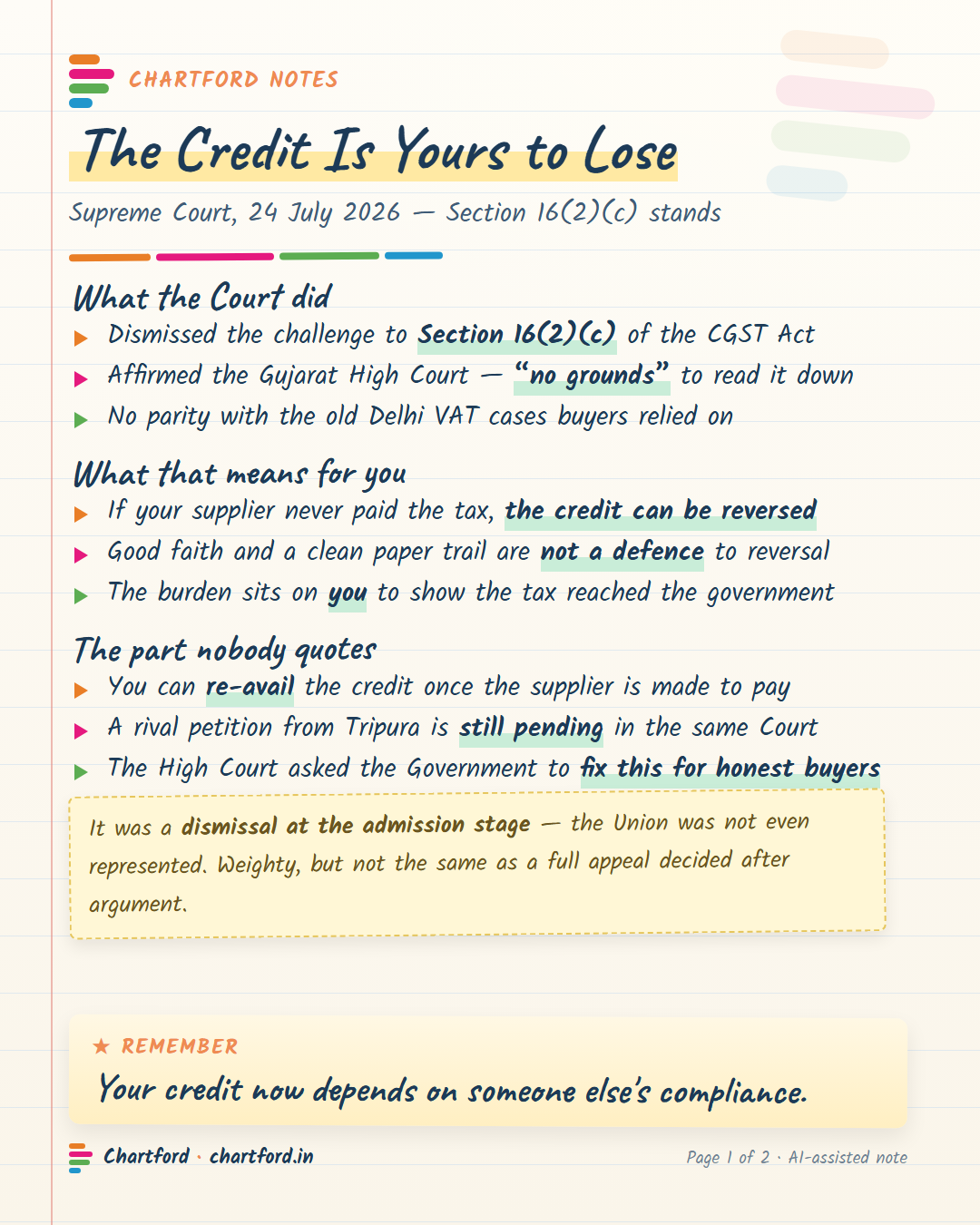
On 24 July 2026 the Supreme Court settled a question that has hung over every GST-registered buyer in the country: if your supplier takes your money, issues a proper invoice, and then never pays the tax to the government — is the credit still yours?
The answer is no. And the reasoning matters more than the headline.
What actually happened
Three petitions — led by Bhandari Scrap Traders — challenged the constitutional validity of Section 16(2)(c) of the CGST Act, the clause that makes your input tax credit conditional on the supplier actually paying the tax. They had lost before the Gujarat High Court in Maruti Enterprise on 1 May 2026, and asked the Supreme Court for leave to appeal.
A Bench of Justices Sanjay Kumar and Sanjeev Sachdeva refused. In its order the Court said:
“We find ourselves in complete and respectful agreement with the views expressed by the High Court of Gujarat and affirm and uphold the impugned judgment. The special leave petitions are, accordingly, dismissed.”
Why the old case law stopped working
For years, buyers facing this demand reached for a line of Delhi VAT decisions holding that a bona fide purchaser should not suffer for a seller's default. The Supreme Court has now closed that door explicitly, finding
“no possibility of drawing parity between the provisions of the two enactments, so as to treat a purchasing dealer under the CGST Act on par with a purported bonafide purchasing dealer under the Delhi VAT Act in relation to ITC, when the supplier-dealer fails to pay the requisite tax.”
Read plainly: under GST, being honest is not by itself a defence to reversal. The Gujarat High Court had put the burden squarely on the buyer — it is for the purchasing dealer to prove that the tax collected was actually remitted to the government.
Three things the headlines are getting wrong
1. This was not a full appeal. It was an order at the admission stage refusing leave. The order records no appearance at all for the respondents. That is still a reasoned order from the Supreme Court agreeing with a High Court, and it should be treated as the current position — but it is not the same as an appeal decided after both sides argued it, and it is more open to being distinguished on different facts.
2. The issue is not fully closed. The order itself notes that a separate petition has been entertained against the Tripura High Court's contrary decision in Sahil Enterprises. The Court distinguished it on the ground that the Tripura High Court had not carried out the detailed analysis the Gujarat High Court did. So a live petition on the other side of this split is still pending. Anyone telling you the law is finally settled is ahead of the record.
3. Reversal is not confiscation. The Court went out of its way to record that under Section 41 read with Sections 73 and 74, a buyer is
“entitled to re-avail the reversed ITC after the supplier-dealer is made to discharge the tax liability.”
The credit is suspended, not destroyed. That is a cash-flow problem and a follow-up problem — serious, but not the same as losing the money for good.
The mechanism you will actually meet: Rule 37A
Most buyers will never see a constitutional argument. They will meet Rule 37A:
- If your supplier has not filed their GSTR-3B for the relevant period by 30 September following the end of that financial year,
- you must reverse the credit by 30 November following that year,
- and if you do not, it becomes payable with interest,
- but you may re-avail it in any later GSTR-3B once the supplier files.
One trap worth naming: Circulars 183/2022 and 193/2023 do not rescue you here. Those deal with a supplier who filed and paid but mis-reported in GSTR-1, leaving a 2A/3B mismatch. They say nothing for a supplier who never paid at all.
What the judgment tells you to do — and most reports skip
The Gujarat High Court did not simply side with the department. It set out what a careful buyer is expected to do, and asked the Government to fix the system. Three practical instructions come out of it:
- Do diligence before you buy, not after the notice. The Court expects a bona fide purchaser to exercise due diligence — which today means looking at a supplier's filing history, not merely that a GSTIN exists.
- Stop dealing once you know. The judgment says a buyer who becomes aware of a supplier's non-compliance should refrain from further transactions that perpetuate the credit chain. Continuing to buy after a red flag is what converts misfortune into a finding against you.
- Put it in the contract. The Court pointed to indemnity clauses — a term making the supplier liable for your loss if they fail to pay. Cheap to add, and one of the few protections entirely within your control.
The Court also borrowed the European test of whether a recipient knew or ought to have known that the purchase was connected with an evasion of tax. That test is not written into the CGST Act, and should not be quoted as if it were — but it shows the direction judicial thinking is taking.
Notably, the High Court closed by asking the Government to build a technology-driven tracking mechanism so genuine buyers are insulated from their vendors' defaults, and said it expects the issue of genuine purchasers to be addressed “at the earliest”. The relief, in other words, is expected to come from Parliament or the GST Council, not the courts.
What to do in your own business this month
- Use IMS properly. Reject what you did not buy. Taking no action counts as acceptance, and an accepted invoice flows into your GSTR-2B and your return.
- Reconcile GSTR-2B against your purchase register before you file, not at year end.
- Watch your top suppliers' filing status the way you watch their delivery dates. Concentration is the risk: one large non-filer can move real money.
- Keep the evidence file anyway — invoice, e-way bill, transport proof, banking-channel payment. It will not, by itself, defeat a Section 16(2)(c) reversal, but it is what separates you from an allegation of a sham transaction, which is a far worse place to be.
That distinction is the link to our earlier note on what happens when a supplier's registration is cancelled later. A documented, genuine buyer still has strong protection against a fraud demand under Section 74. What this month's order confirms is that protection from a fraud allegation is not the same as keeping the credit.
Where to read it yourself
- Supreme Court order, SLP(C) No. 23931/2026 with 24088/2026 and 24103/2026, dated 24 July 2026 (arising out of Gujarat High Court, SCA No. 749/2025).
- Gujarat High Court, Maruti Enterprise v. Union of India, R/SCA 18080/2023 and allied matters, judgment dated 1 May 2026.
- Section 16 of the CGST Act on the CBIC tax information portal.
- Circular 183/15/2022-GST and Circular 193/05/2023-GST — the mismatch circulars, and their limits.
- GSTN FAQs on the Invoice Management System.
If you have received a Section 16(2)(c) demand, or you want your supplier contracts and monthly reconciliation tightened before you do, talk to Chartford. This is the kind of exposure that is cheap to prevent and expensive to argue.
AI-assisted note, reviewed by Chartford Consultancy. Rules and figures can change with government notifications — talk to us to confirm exactly what applies to your business.